Scottish Dragons: Why They Were Nothing Like the Dragons of Fantasy
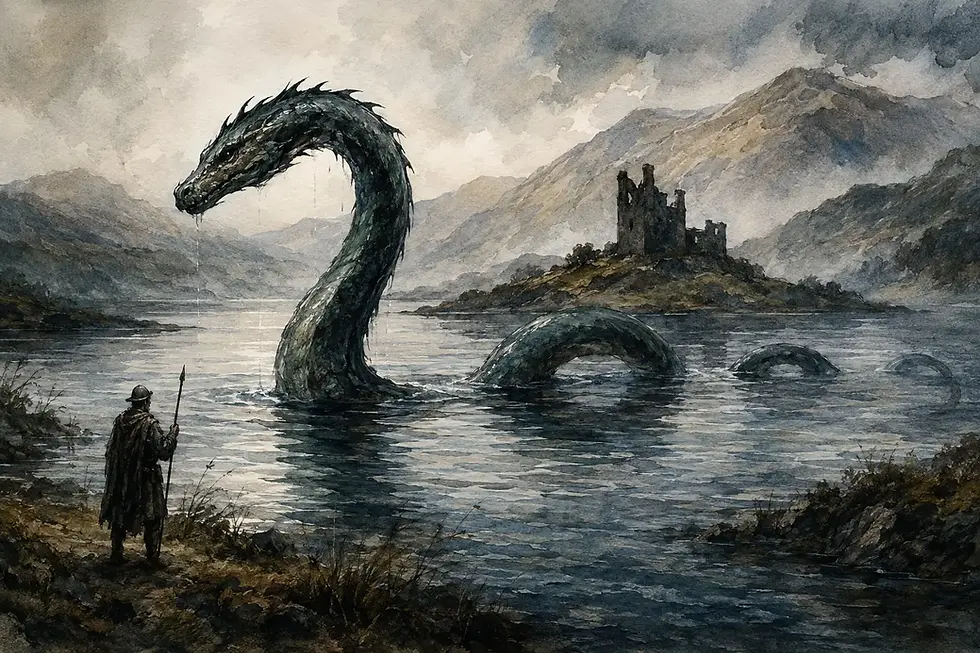
When most people picture a dragon, they imagine a gigantic winged creature soaring through the sky, breathing fire and guarding treasure. It is an image shaped by medieval Europe, modern fantasy and films like The Hobbit and Game of Thrones.
Scottish dragons were something entirely different.
Long before fantasy dragons became part of popular culture, Scotland had its own dragon traditions. These creatures were rarely described as winged monsters descending from the clouds. Instead, they were enormous serpent-like beasts said to inhabit lochs, rivers, caves and remote glens. They were feared not because they could fly or breathe fire, but because people believed they were dangerous creatures living in the landscape around them.
That difference is one reason Scottish dragon mythology remains so fascinating today. If these stories bear so little resemblance to the dragons of fantasy, what inspired them?

What Did Scottish Dragons Really Look Like?
Many of the creatures described in Scottish dragon folklore were known as worms, wyrms or beithirs. Despite the names, these were no ordinary snakes. They were described as enormous serpentine creatures, sometimes so large they could dominate an entire valley or block a river.
Unlike the dragons of medieval fantasy, many Scottish dragons had no wings. Many traditions also describe them as legless or with only tiny limbs, making them appear far closer to giant serpents than reptiles. Rather than breathing fire, some legends claimed they possessed poisonous bites or poisonous breath capable of killing livestock and bringing sickness to those unfortunate enough to encounter them.
If you removed the word dragon from many of these stories, the descriptions sound surprisingly animal-like.
Scottish Dragons Didn't Breathe Fire
Perhaps the biggest misconception is that dragons have always breathed fire.
In Scottish mythology, that simply wasn't the defining feature. Many legends instead describe creatures that poisoned water, attacked livestock, stalked lonely places and terrified nearby communities.
These stories portray dragons as physical dangers rather than magical monsters. Farmers feared for their animals. Travellers avoided certain routes. Entire communities believed particular caves, rivers or lochs were home to something they should never disturb.
That makes Scottish dragon folklore feel remarkably different from the dragons that dominate modern fantasy.

Where Scottish Dragons Were Said to Live
One of the most striking aspects of Scottish dragon legends is how closely they are tied to real places.
Rather than existing in imaginary kingdoms, dragons were believed to inhabit specific locations across Scotland. Deep lochs, fast-flowing rivers, sea caves, marshes and isolated glens appear repeatedly throughout the folklore.
This connection to the landscape is part of what makes these stories so compelling. Many of the places associated with dragon legends can still be visited today. Standing beside a dark Highland loch or looking into the entrance of a remote cave, it is easy to understand why earlier generations imagined enormous creatures living there.
Unlike many mythical beasts, Scottish dragons were never separated from the real world. They belonged to places that people walked past every day.
Famous Scottish Dragon Legends
Perhaps the best-known dragon-like creature in Scottish mythology is the Beithir, a gigantic serpent associated with the Highlands. Usually connected with water, caves and mountain streams, the Beithir was said to emerge from hidden places to attack anyone unfortunate enough to cross its path. Many stories claimed it possessed a deadly poisonous bite, making it one of the most feared creatures in Highland folklore.
Another famous example is the Kinnoull Hill Dragon near Perth. According to local tradition, the dragon terrorised the surrounding countryside until it was eventually slain by St Serf. The legend has survived for centuries and continues to inspire local events celebrating Perthshire's folklore.
Further north, the Stoor Worm became one of the great sea serpents of northern tradition. Although most closely associated with Orkney, it forms part of Scotland's wider dragon mythology. Rather than breathing fire, the Stoor Worm was simply colossal, a creature whose immense size alone inspired fear.
Although each story differs, they all share something unusual. Their dragons belonged to real landscapes and were believed to be genuine threats rather than distant fantasy creatures.

Could Scottish Dragons Have Been Inspired by Real Animals?
This is where the discussion becomes particularly interesting.
There is no archaeological evidence that giant, fire-breathing dragons once lived in Scotland.
However, folklore often begins with genuine experiences before becoming embellished over generations.
Across the world, legends have frequently grown from encounters with unfamiliar animals. The Kraken is widely believed to have been inspired by giant squid. Fossilised mammoth skulls may have contributed to stories of one-eyed giants in the ancient Mediterranean. Large crocodiles, giant snakes and unfamiliar marine animals have all inspired myths in different cultures.
Could Scottish dragon legends have followed a similar path?
Some researchers have suggested that unusually large eels, seals glimpsed in poor conditions, stranded marine animals or other unfamiliar creatures may have contributed to stories that gradually became more dramatic with each retelling.
Or perhaps there genuinely was a large serpent-like animal that once inhabited the Scottish Highlands before eventually disappearing from the landscape. There is no evidence that such a creature has ever existed, but history has shown that species can disappear, leaving behind little more than fragments of memory and legend.
Others argue that dragons simply became symbols of danger, chaos and the untamed wilderness.
There is no way to prove any of these ideas.
But the fact that Scottish dragons were described so differently from the dragons of fantasy continues to raise fascinating questions. They do not sound like magical beasts soaring through the clouds. They sound far closer to creatures that people genuinely believed could exist.
Why Scottish Dragons Are So Different From Fantasy Dragons
The dragons most people recognise today owe much of their appearance to medieval European artwork and later fantasy literature.
Scottish dragons belong to a far older storytelling tradition.
They were woven into the landscape, attached to specific hills, rivers, caves and lochs, and remembered as creatures capable of causing genuine harm. They did not exist in distant fantasy kingdoms. According to the stories, they lived just beyond the next hill, beneath the surface of a nearby loch or deep inside an isolated cave.
Perhaps that is why Scottish dragons continue to feel so different. They are less like fantasy monsters and more like forgotten creatures that once belonged to the wild places of Scotland.
Why Do These Stories Still Fascinate Us?
Whether Scottish dragons were inspired by misunderstood animals, exaggerated encounters or simply generations of storytelling, they remain one of the most intriguing parts of Scottish mythology.
Their legends remind us that folklore rarely appears from nowhere. Stories grow from landscapes, fears and experiences that people struggle to explain. Over centuries those stories change, evolve and become woven into local history until the line between memory and mythology becomes almost impossible to separate.
The wild places of Scotland have always inspired wonder. Dense forests, deep lochs, lonely mountains and hidden caves create the perfect setting for stories of enormous serpent-like creatures lurking just out of sight.
Perhaps that is why these legends have survived for hundreds of years.
Were Scottish Dragons Inspired by Real Creatures?
We'll probably never know.
What we do know is that Scottish dragons were nothing like the dragons of fantasy. They were long, serpent-like creatures tied to Scotland's landscape and remembered through generations of folklore.
Whether those stories preserve distant memories of real animals, describe creatures that have long since disappeared, or are simply some of Scotland's greatest legends is something each reader must decide for themselves.
What do you think? Were Scottish dragons inspired by real creatures... or are they simply folklore?
Discover Our Highland-Made Products
Explore our range of Scottish-made beard and body care products, inspired by the forests, coastlines and landscapes of the Highlands. Every purchase also helps support rewilding projects across Scotland.


